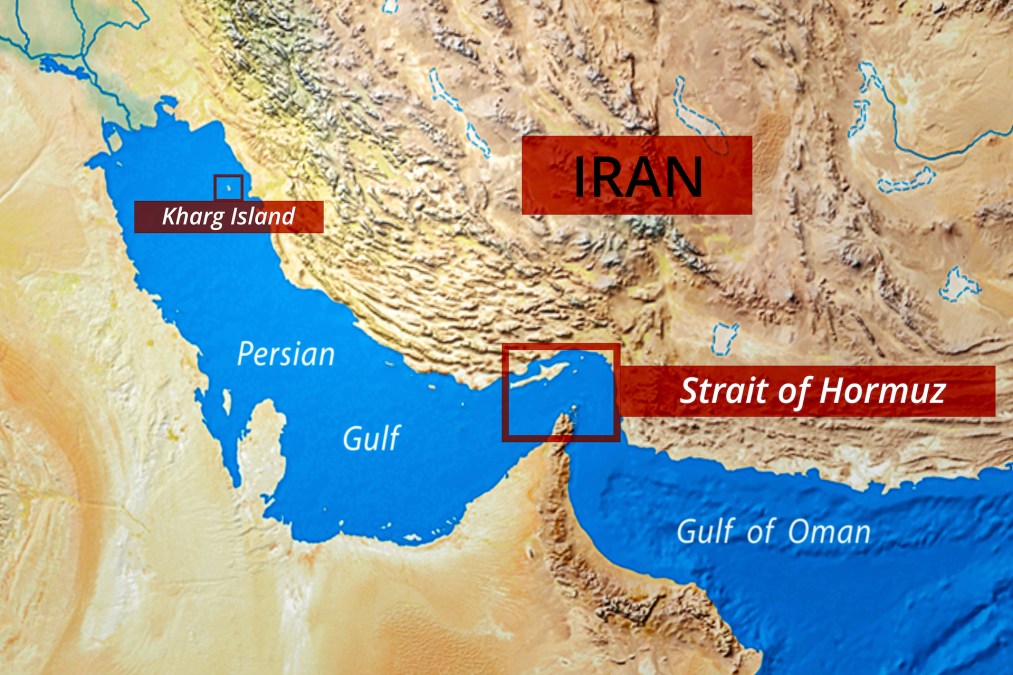
Look at a map of the Persian Gulf and one feature jumps out: a narrow kink of water between Iran and the tip of Oman, no wider than the drive from downtown Manhattan to Newark Airport. That sliver is the Strait of Hormuz. In a normal year, about a quarter of the world's seaborne oil and roughly a fifth of its liquefied natural gas funnel through it every day — a daily flow of somewhere between 15 and 21 million barrels of crude, plus a staggering share of the Gulf's other imports and exports.
Twenty-one nautical miles wide at its narrowest point, the Strait is the kind of geographic feature that forces the world to pay attention to it. And as of early 2026, the world is paying attention again. After the United States and Israel launched Operation Epic Fury against Iranian targets on February 28th, traffic through the Strait collapsed from roughly 140 ships per day to a handful. Insurance premiums on tankers jumped from a baseline of around 0.125% of hull value per transit to as much as 5%. Brent crude closed above $100 per barrel on March 8th for the first time in four years. A temporary ceasefire on April 8th has eased things — but Iran has reportedly begun charging transit tolls north of a million dollars per vessel to resume commerce, which is exactly the kind of sentence that nobody in the shipping industry wanted to read.
What a lot of people don't appreciate is how long this has been the case. The Strait has been at the center of control and turmoil for as long as ships have sailed it. It was a strategic choke point two and a half millennia before anyone drew it on a modern chart. Empires have risen and fallen around it. Fortresses have been built on its islands and torn down again. Pearls, spices, horses, pilgrims, slaves, cannon, and — more recently — rifles and ammunition have moved through it in a continuous, mostly underappreciated stream.
This is a long piece. If you've been curious about why the Strait of Hormuz matters, what's actually moved through it historically, what firearms industry sits along its shores today, and what the current 2026 crisis actually looks like when you dig into the numbers, settle in.
The Geography of a Choke Point
The Strait of Hormuz connects the Persian Gulf to the Gulf of Oman and, beyond that, the Arabian Sea and Indian Ocean. At its narrowest, measured between Iran's coast and the tip of Oman's Musandam Peninsula, the entire waterway is about 21 nautical miles — roughly 39 kilometers — across. But the actual usable shipping lanes are much narrower than that: two one-way traffic separation lanes each two nautical miles wide, with a two-mile-wide median buffer between them. Outbound traffic uses one lane, inbound the other.
Every commercial cargo heading in or out of Kuwait, Bahrain, Qatar, the eastern coast of Saudi Arabia, the United Arab Emirates, southern Iraq, and Iran itself has to thread that needle. So does every warship, every tanker, every LNG carrier, every container ship — and historically every dhow loaded with pearls or spices.
The Iranian side of the Strait is dotted with a cluster of strategically positioned islands — Qeshm, the largest, plus Hormuz Island (which gave the Strait its name), Larak, Hengam, and several smaller features. These islands have provided naval bases, customs posts, and lookout points for every power that has controlled them — from the medieval Kingdom of Hormuz to the Portuguese to the modern Iranian Revolutionary Guard Corps, which maintains bases on several of them today.
The name itself is old and contested. Some scholars trace it to the Zoroastrian deity Ahura Mazda (Middle Persian Ohrmazd or Hormoz). Others connect it to the local word Hur-Mogh, said to mean "Place of Dates." A third tradition links it to Ifra Hormizd, the mother of the Sasanian king Shapur II. What's certain is that the Kingdom of Ormus existed in some form from the 10th through the 17th centuries — that alone tells you how long this region has had a name recognized by the outside world.
Ancient Origins: Sumer, Persia, and the Classical World
Evidence of maritime trade through the Strait goes back to at least the third millennium BCE. Sumerian cuneiform tablets describe shipments of copper arriving in Mesopotamia from Magan — generally identified with modern Oman — and more exotic goods coming from Meluhha, most likely the Indus Valley civilization centered in modern Pakistan. The timber-and-reed ships carrying that cargo had to sail through Hormuz.
By the Achaemenid Persian Empire (roughly 550–330 BCE), the Strait sat in the middle of a unified imperial maritime network connecting the Indus to Egypt. The Achaemenid fleet, under commanders like Scylax of Caryanda, ran expeditions that passed through the Strait and up the Red Sea. Greek historians — Herodotus, Nearchus, Arrian — all wrote about ships moving along this route.
The best-documented early voyage comes from the tail end of Alexander the Great's campaigns. In 326 BCE, Alexander dispatched his Cretan-born admiral Nearchus with a fleet to sail from the mouth of the Indus back to Mesopotamia while the main army marched overland. Nearchus's fleet worked its way along the Makran coast of modern Pakistan and Iran, entered the Persian Gulf through the Strait of Hormuz, and by 324 BCE had reached the mouth of the Tigris, where Nearchus rejoined Alexander at Susa. He wrote his own account of the voyage — the Indike — which is now lost, but the second-century AD historian Arrian preserved long passages of it in his own Indica, including Nearchus's description of sighting the Omani peninsula from the Strait.
For over two thousand years after that, Western classical geographers had a surprisingly accurate picture of the Strait largely because of what Nearchus wrote down.
Through the Parthian and Sasanian eras that followed, Persian Gulf ports like Siraf on the Iranian coast boomed on the back of trade with India, East Africa, and Tang Dynasty China. Ninth-century Chinese records describe Arab and Persian merchants arriving in Canton (Guangzhou) who had set sail from ports just inside Hormuz. A journey of that length — Basra or Siraf to southern China and back — could take a merchant most of two years and make him wealthy for life if the cargo arrived intact.
The Medieval Kingdom of Hormuz
After the Islamic conquests of the seventh century, the Strait became part of a sprawling Muslim-dominated trade system stretching from Spain to Indonesia. The Kingdom of Hormuz — a Persian-speaking principality nominally paying tribute to larger powers but functionally independent — emerged around the 10th century. In the 14th century, facing repeated raids on its mainland capital, the ruling dynasty moved its court to the defensible Jerun Island, renaming it New Hormuz. That island sits in what is today the outer harbor of Bandar Abbas.
For two hundred years, New Hormuz became one of the richest trading states in the Indian Ocean world. Its merchants handled:
- Pearls harvested from Gulf oyster beds — a major luxury export to India, the Ottoman world, and Europe.
- Horses from Arabia and Persia, shipped live to India in specialized horse transports, where they were bought at enormous prices by Hindu and Muslim rulers whose armies depended on cavalry. A single good Persian horse could fetch sums that would pay a master craftsman's wages for several years.
- Spices transshipped from Indian and Southeast Asian ports onward to Basra, Aleppo, and the Mediterranean.
- Silk, porcelain, and camphor from China.
- Copper, tin, and iron — essential raw materials for metalwork, including the gun-founding industries that were starting to emerge.
- Slaves from East Africa and the Caucasus, tragically a large share of Hormuz's commerce.
Ibn Battuta passed through in the mid-14th century. Marco Polo described it a generation earlier as a place "where merchants from India come with many ships and wares" and called it one of the most commercially active cities he had ever seen. When the Chinese Ming-era admiral Zheng He sent his treasure fleet into the Indian Ocean in the early 15th century, Hormuz was one of its destinations. Chinese accounts describe the city's markets and note the quality of its horses.
The Portuguese Century: 1507–1622
Everything changed in September 1507. A Portuguese fleet under Afonso de Albuquerque — fresh from campaigns along the East African and Arabian coasts — approached Hormuz Island with cannon. Albuquerque was methodically working his way from Africa to India to the Spice Islands, and he had figured out what every imperial strategist before and after him figured out — that a fortified position at Hormuz meant a hand on the throat of Gulf commerce.
The Portuguese took Hormuz after a brief campaign culminating on September 26, 1507. Albuquerque's men promptly began constructing what would become the Fortaleza de Nossa Senhora da Conceição — the Fort of Our Lady of the Conception. Its ruins still stand on Hormuz Island. The fortress was designed as an irregular pentagon with seven projecting towers, a distinctive early-modern European bastion structure that signaled, unmistakably, that a new kind of power had arrived in the Gulf.
For the next hundred and fifteen years, Portugal effectively taxed every significant ship transiting the Strait. Portuguese factors at Hormuz kept meticulous customs records; modern historians have used those to reconstruct an unusually precise picture of what was moving through the Gulf during that century. Contemporary accounts put Hormuz's annual revenue to the Portuguese crown at somewhere between 140,000 and 200,000 cruzados — a figure that, adjusted for the era's purchasing power, made Hormuz one of the most lucrative single possessions of the Portuguese empire.
This is also the period when firearms first passed through the Strait in large numbers in both directions. Portuguese matchlock arquebuses, swivel guns, and cannon reached Persia, India, and further east partly through this route. Indian and Persian gunsmiths copied and adapted them. Arab traders carried early firearms southward into East Africa. For the first time in human history, a steady flow of guns and powder ran through the Strait — the beginning of a pattern that never really stopped.
The Safavid–English Reconquest, 1622
By the early 17th century, Portuguese power in the Indian Ocean was fraying. Dutch and English East India Companies were pushing into trade routes Portugal had monopolized for a century. In Persia, the Safavid Shah Abbas I — "Abbas the Great" — wanted the Portuguese out of his Gulf waters. He offered the English East India Company a deal: help us take Hormuz, and we'll share the customs revenues and grant you access to the Persian silk trade.
The English agreed. In February 1622, a combined Persian–English force began the siege. The Persian commander was Imam Quli Khan, son of Allahverdi Khan and one of the Safavid state's most capable generals. The English contingent, under Captain Blythe, brought five warships and four pinnaces. The Portuguese garrison of roughly a thousand men, under Simão de Melo, held out for more than two months before the garrison mutinied on April 22nd. The following day — April 23, 1622 — the city surrendered.
The English did well out of the deal. They collected half the customs, took their share of the spoils, received prisoner repatriations sorted by religion, and had the Persians pay for half their fleet's supplies. Individual English grandees did even better: the Duke of Buckingham and King James I each pocketed an unofficial 10,000-pound payoff from the operation. (Some things never change.) And Portugal, after a century as the Gulf's dominant European power, pulled back to Muscat and the East African coast. The nearby Persian port of Bandar Abbas — named for Shah Abbas — replaced the old Portuguese island capital as the region's commercial hub.
British Gunboats and the Pax Britannica
From the late 18th century through the mid-20th, the Strait sat in the center of British imperial interests. The East India Company and later the Royal Navy used it to connect India to Britain — and to suppress what the British classified as piracy. A lot of that classification was self-serving; the Qawasim (Al Qasimi) tribal confederation based on what is now the UAE coast had legitimate grievances about British incursions into regional trade, and their resistance was in many cases less piratical than the label implied. Either way, the Royal Navy moved against them.
A first British expedition hit Ras al-Khaimah in 1809, producing a peace treaty that quickly broke down. In the autumn of 1819, a much larger force of roughly 3,000 troops — 1,645 European soldiers and marines, 1,424 Indian sepoys — under Major-General William Keir Grant, sailing on HMS Liverpool, Eden, and Curlew plus six East India Company armed vessels, destroyed Qawasim strongholds over a campaign lasting from November 3rd to December 22nd. The result was the General Maritime Treaty of 1820, which required Gulf sheikhs to renounce "piracy" and slavery and to fly distinctive red-and-white maritime flags — the ancestors, in a direct sense, of the flags of the modern UAE emirates.
That treaty framework became the backbone of what the British called the "Trucial Coast" — the seven sheikhdoms that would eventually, in 1971, become the United Arab Emirates. The arrangement gave the British naval supremacy in the Gulf for a century and a half.
Under the Pax Britannica, the Strait carried:
- Indian cotton textiles to the Gulf and East Africa.
- Dates from Iraq — in the early 20th century, Iraq was the world's largest date exporter, and many of those dates went out through the Strait.
- Pearls, still — the Gulf pearling industry peaked in the early 20th century before Japanese cultured pearls crushed it in a handful of years.
- Pilgrims en route to Mecca from Iran, India, and East Africa.
- British, Indian, and later American military shipments — including firearms redistributed throughout the empire.
Then came oil.
The Oil Age Transforms Everything
On the morning of May 26, 1908, a drill crew under the supervision of the British geologist George Bernard Reynolds struck oil at Masjed Soleyman in southwestern Iran. Reynolds had been given orders to wind up the project and come home — the money had run out — but he stalled on following those orders just long enough for the strike to come in. The commercial oil field he proved up became the foundation of the Anglo-Persian Oil Company, chartered on April 14, 1909. In 1954, after several intervening name changes, it became British Petroleum. Today we know it as BP.
Reynolds's discovery was the first major commercial oil find in the Middle East. Over the next three decades, similar discoveries transformed the entire Gulf:
- Bahrain: 1932
- Saudi Arabia (Dammam No. 7): 1938
- Kuwait (Burgan): 1938
- Qatar (Dukhan): 1940
- Abu Dhabi (Bab): 1958, onshore; 1958, offshore
By the 1950s and 60s, tankers were the dominant traffic through the Strait. By the 1970s, oil exports from Gulf states were funding entire modern economies — highways, airports, universities, military establishments. Several firearms-relevant developments came out of that wealth:
- Iran, Saudi Arabia, and the Gulf states became major importers of Western and Soviet arms. Aircraft, naval vessels, tanks, small arms, and ammunition moved into the region in quantities that would have been unimaginable a generation earlier. Most of it came through the Strait.
- Domestic arms industries began to form. Iran's Defense Industries Organization (DIO), Pakistan Ordnance Factories (POF) at Wah Cantonment, and eventually the UAE's CARACAL all have their roots in this period of booming oil revenue and strategic investment.
- Sea-lane security became a first-order U.S. and allied priority. The U.S. Fifth Fleet, headquartered in Bahrain, exists largely because of the Strait.
The Tanker War: 1980–1988
The first time the Strait became a household name in the United States was during the Iran–Iraq War (1980–1988). Starting in 1981 and escalating sharply after Iraq expanded its attacks on Iran's Kharg Island oil terminal in 1984, both belligerents began attacking neutral tankers moving oil for the other side. The campaign became known as the Tanker War. By the time it ended, 451 commercial ships had been attacked — 283 by Iraq, 168 by Iran — and well over 100 sailors were dead.
Kuwait's tankers were among the most frequently targeted. In 1986 Kuwait formally requested protection from both the United States and the Soviet Union. The U.S. response, Operation Earnest Will, ran from July 24, 1987 to September 26, 1988 and reflagged Kuwaiti tankers as American vessels, escorting them through the Gulf with U.S. Navy warships. It remains one of the largest naval convoy operations the United States has conducted since World War II.
Several specific incidents from that period still shape U.S. naval doctrine today:
The USS Stark Incident — May 17, 1987
An Iraqi warplane — initially reported as a Mirage F1, though later analyses suggested it may have been a Dassault Falcon 50 business jet modified with radar and anti-ship missile hardpoints — fired two Exocet missiles at the U.S. frigate USS Stark (FFG-31). The first was launched from about 22 miles out, the second from about 15 miles out, arriving 30 seconds later. Thirty-seven American sailors died: 29 killed in the initial explosion and fire (including two lost at sea), and eight more who died of their injuries. Iraq apologized, Saddam Hussein claimed the pilot had mistaken the frigate for an Iranian tanker, and the United States accepted the apology for reasons of broader strategy — at that moment, Washington was effectively supporting Iraq against Iran.
The USS Samuel B. Roberts Mine Strike — April 14, 1988
The frigate USS Samuel B. Roberts hit an Iranian-laid mine in the central Persian Gulf, blowing a massive hole in its hull. Ten sailors were injured; the ship was nearly lost but her crew saved her. Forensic examination of nearby mines recovered in the water matched them to Iranian markings, giving the United States a clear justification for retaliation.
Operation Praying Mantis — April 18, 1988
Four days after the Samuel B. Roberts mine strike, U.S. surface forces and naval aviation carried out Operation Praying Mantis, the largest of the five major surface engagements the U.S. Navy has fought since World War II. Across a single day, U.S. forces:
- Destroyed the Sassan and Sirri oil platforms, which Iran had been using as military observation and staging bases. (The Sirri platforms were demolished after the war due to the damage.)
- Sank the Iranian fast-attack craft IRIS Joshan, a Kaman-class missile boat, with Standard and Harpoon missiles and naval gunfire.
- Sank the Iranian frigate IRIS Sahand — fires on its decks reached its magazines and caused a catastrophic explosion.
- Crippled a second Iranian frigate, IRIS Sabalan, which was later repaired.
- Sank multiple armed Iranian speedboats (Boghammars).
Two American Marines — the pilots of an AH-1T Sea Cobra helicopter — died when their aircraft crashed during the operation; Navy officials reported the crash showed no signs of battle damage. It remains the most significant American surface naval engagement since Leyte Gulf.
Iran Air Flight 655 — July 3, 1988
Less than three months later, the U.S. cruiser USS Vincennes (CG-49), a Ticonderoga-class guided-missile cruiser, engaged what its crew identified as an incoming Iranian F-14 Tomcat. What they actually shot down was an Iran Air Airbus A300B2-203 (registration EP-IBU), Flight 655, flying a scheduled route from Bandar Abbas to Dubai. Two SM-2MR surface-to-air missiles intercepted the airliner at a range of about eight nautical miles. All 290 people aboard — 274 passengers and 16 crew, including 66 children — were killed.
A detail that took years to come out in full: the Vincennes was, at the moment of the shootdown, inside Iranian territorial waters. The U.S. Navy initially denied this, but in 1992 Admiral William Crowe publicly acknowledged it on Nightline, and the United States conceded the point in legal filings related to Iran's suit before the International Court of Justice. The incident remains one of the deepest and most specific grievances Iran carries in its relationship with the United States.
By the time the Iran–Iraq War ended a few months later, the Strait had been militarized in ways that never really reversed.
Firearms Manufacturing On and Around the Strait
This is the section many of our readers have probably been waiting for. The region around the Strait — and its immediate approaches — hosts several firearms industries that matter to global arms markets.
CARACAL International (United Arab Emirates)
CARACAL International, headquartered in Abu Dhabi and founded in 2007, is the most visible firearms manufacturer actually on the Strait. It's part of the UAE's effort to build an indigenous defense industry under the Tawazun holding group. CARACAL produces:
- Striker-fired polymer-frame pistols (the Caracal F and Caracal Enhanced F, along with subcompact variants).
- A gas-piston AR-pattern rifle family: the CAR 814, CAR 816, and CAR 817AR, chambered in 5.56×45mm, 300 Blackout, and 7.62×51mm respectively.
- Bolt-action precision rifles and training ammunition.
CARACAL pistols briefly entered the U.S. civilian market in the early 2010s and built a following for their ergonomics and trigger before a voluntary safety recall and import complications pulled them back from American shelves. Company rifles have been adopted by several Middle Eastern and African militaries and law enforcement agencies.
Iran's Defense Industries Organization
Iran's state-owned DIO was consolidated into its current form in late 1981, pulling together the arms-production elements of the pre-revolutionary Military Industries Organization. Under decades of sanctions, DIO has taken an interesting path: rather than import modern small arms, it has reverse-engineered them.
Its flagship infantry rifle project, the KH-2002 Khaybar, is a case study in iterated copying. The KH-2002 is a bullpup conversion of Iran's domestic S-5.56 rifle — which is itself an unlicensed copy of the Chinese Norinco CQ — which is itself an unlicensed copy of the American Colt M16A1. In other words, it's a third-generation M16 derivative, dressed in bullpup furniture. It feeds from STANAG magazines. When Iran sent ten samples to Syria for evaluation against the AK-74M in 2008, eight of the ten jammed repeatedly during testing. Reports suggest DIO effectively discontinued KH-2002 production around 2012 after failing to land export customers. The IRGC remains the primary user.
DIO also produces a range of licensed and unlicensed copies of German firearms dating back to pre-revolutionary production agreements with Heckler & Koch — including variants in the G3 family — as well as sniper rifles, pistols, and machine guns. None of this product line reaches Western civilian markets in any meaningful volume due to sanctions.
Pakistan Ordnance Factories
POF at Wah Cantonment, while not on the Strait itself, produces arms that transit the region constantly. POF manufactures licensed G3 rifles, MP5 submachine guns, PK machine guns, and pistols, and exports to African, Asian, and Middle Eastern militaries. A lot of that outbound cargo moves through Gulf ports.
The Khyber Pass Copyists
Along the Afghanistan–Pakistan border, tribal gunsmiths have produced handmade copies of nearly every military rifle to enter the region — Martini-Henrys, Lee-Enfields, Mausers, AKs, and more — for well over a century. "Khyber Pass copies" have legendarily variable quality, ranging from surprisingly good to actively dangerous to the shooter. The tradition speaks to the depth of regional gunmaking culture, and many of the raw materials and components that have fed this informal industry over the decades arrived through Gulf ports.
Turkey's Arms Industry (Approaches)
Turkey is not on the Strait, but Turkish manufacturers — Canik, Sarsilmaz, Girsan, Tisas — ship extensively into and out of the Gulf. Canik pistols in particular have become a major presence in the U.S. civilian market over the last decade, and a meaningful share of that production has at various points routed through Gulf logistics hubs.
The Modern Cadence: 1990–2024
Since the end of the Iran–Iraq War, the Strait has seen a recurring rhythm: periods of quiet interrupted by flare-ups that briefly spike oil prices and remind the world how precarious the arrangement is.
- 1990–91 Gulf War. The liberation of Kuwait ran through Gulf ports and restored normal commercial shipping through the Strait within months.
- 2003 Iraq War. Operations staged out of Kuwait, Bahrain, and Qatar, all dependent on the Strait.
- 2019 tanker seizures. Iran's IRGC seized the British-flagged Stena Impero in July, in apparent retaliation for Gibraltar's earlier detention of the Iranian-flagged Grace 1 (renamed Adrian Darya 1). Both were eventually released. The same year saw the mysterious June attacks on two tankers — the Front Altair and the Kokuka Courageous — in the Gulf of Oman, which the United States attributed to Iran.
- 2019 Abqaiq attack. A drone-and-cruise-missile strike on Saudi Aramco facilities at Abqaiq and Khurais briefly knocked out roughly 5% of global oil supply. The Houthis claimed responsibility; U.S. and Saudi officials pointed at Iran.
- 2020 Soleimani strike. After the U.S. drone strike killed IRGC Quds Force commander Qassem Soleimani, Iran retaliated with ballistic missile strikes on U.S. bases in Iraq. Shipping through the Strait held its breath and kept moving.
- 2022–2024 seizures and drone incidents. A continuing pattern of tit-for-tat incidents. None quite tipped into major closure.
The 2026 Crisis — Where Things Stand Right Now
On February 28, 2026, the United States and Israel launched coordinated strikes against Iranian military, nuclear, and leadership targets — Operation Epic Fury on the American side, Operation Roaring Lion on the Israeli side. Within 72 hours, the Strait of Hormuz was effectively a combat zone.
On March 2nd, a senior IRGC official publicly confirmed that Iran considered the Strait closed and threatened any ship that attempted to transit. What followed was the sharpest shipping collapse in the Strait's modern history:
- Traffic dropped roughly 70% within days, then fell further toward near-zero at the peak of the crisis. Daily ship movements collapsed from about 140 to a handful.
- Roughly 150 freight ships, including many oil tankers, stalled in anchorages on either side of the Strait waiting for the situation to clarify.
- War-risk insurance premiums went from a baseline of about 0.125% of hull value per transit to 0.2–0.4%, then — during the worst of the crisis — to as much as 5% of ship value. For a Very Large Crude Carrier (VLCC) worth $100 million, that's a $5 million premium for a single voyage.
- Brent crude broke above $100 per barrel on March 8th — the first four-digit Brent price in four years.
- Selective traffic continued. A short list of tankers kept moving through the Strait during the worst of the crisis, mostly carrying Iranian-origin petroleum bound for China and India, with Iranian clearance arranged in advance.
A temporary ceasefire took effect on April 8, 2026, with the reopening of the Strait as one of the announced terms. But Iran has reportedly begun leveraging its effective control of the waterway by demanding transit tolls, with reports of payments in excess of a million dollars per vessel. As of mid-April 2026, additional war-risks premium (AWRP) levels on tankers and bulk carriers have settled around 1%, with no-claim bonuses of 35–50% for vessels that have stayed in the region without incident. Insurance markets are slowly resuming war-risk cover for some routes that had been entirely withdrawn during the peak.
The big question — whether any of this becomes permanent — is not yet clear. But a central historical point still holds: the Strait has never been completely closed to commercial shipping for any meaningful length of time. Even during the worst weeks of the Tanker War, and even during the recent crisis, commercial traffic continued in reduced form. The incentive for every regional power to keep it open is simply too strong. Iran ships almost all of its own oil through the same waters. A sustained closure hurts Tehran at least as much as it hurts anyone else.
What the Strait Means for the U.S. Firearms Market
At first glance, a waterway halfway around the world might seem disconnected from what you pay for ammunition at your local dealer. It's not. Several connections are direct:
- Energy prices. Any disruption to the Strait spikes global oil prices, which drives up manufacturing and shipping costs for everything made with or moved by petroleum — which is essentially all modern firearms and ammunition. The March 2026 jump to $100+ Brent is already showing up in freight quotes for small-arms containers.
- Copper, zinc, and brass. Much of the metals market moves through Gulf and Asian shipping lanes. Price shocks there eventually show up in the price of brass cases, bullet jackets, and components.
- Smokeless powder and primers. A significant share of global smokeless powder and primer production originates in or transits Asia. The Strait sits on the main maritime artery connecting Asian manufacturers to European and Middle Eastern customers. Disruptions ripple into U.S. availability — we've already seen one U.S. ammunition company (AAC) suspend operations after a powder supplier diverted inventory to military contracts following the outbreak of the Iran conflict.
- Turkish and Gulf firearms imports. Direct impact on the supply of pistols and rifles from brands like Canik and, historically, CARACAL. Shipping insurance surcharges on container traffic through the Strait feed into landed cost.
- Military procurement pressure. Every Tomahawk, Patriot, and THAAD interceptor fired during the recent strikes drew from the same manufacturing base that produces civilian-market components. The Pentagon's recent emergency production agreements with Lockheed Martin and RTX — to quadruple Tomahawk output and quadruple THAAD interceptor production — are a direct signal that these lines will stay saturated with military orders for years.
The Bottom Line
The Strait of Hormuz has been a strategic choke point continuously for at least 2,500 years. It has carried Sumerian copper, Mongol horses, Portuguese cannon, British cotton, Gulf oil, American warships, and — at every one of those stages — weapons of one kind or another. The firearms that U.S. shooters buy today have supply chains that, if you trace them far enough, run through these waters.
Understanding this history isn't just an intellectual exercise. It's part of understanding why sudden news events halfway around the world can affect the price of a box of 9mm on your local shelf. The world is more connected than most of us like to admit, and the Strait is one of the clearest illustrations of that fact. Every few decades the arrangement wobbles. Sometimes badly. It always comes back — because the alternative is a world nobody in the region actually wants to live in. That's been true since Nearchus sailed past the Musandam Peninsula in 325 BCE, and it's true now, as the first post-ceasefire tankers wait their turn to pay Iran's toll and thread the lane.
If you're watching the current situation and wondering what it means for your next firearms or ammunition purchase, we wrote a more tactical piece on exactly that question. See How the Iran Conflict Is Affecting Gun and Ammo Sales in 2026 and our companion piece on Iran's Civilian Gun Ownership Laws.
TheGunDock is a licensed FFL dealer based in Paris, Kentucky. Historical dates, figures, and named incidents in this article were checked against Wikipedia, Britannica, and contemporaneous news reporting at the time of writing. Specific numbers — tanker-attack totals, civilian-ownership rates, transit volumes, insurance rates — are drawn from the best publicly available sources but are approximations by nature and change over time. This article is informational and reflects the broad historical and industry picture as we understand it.